
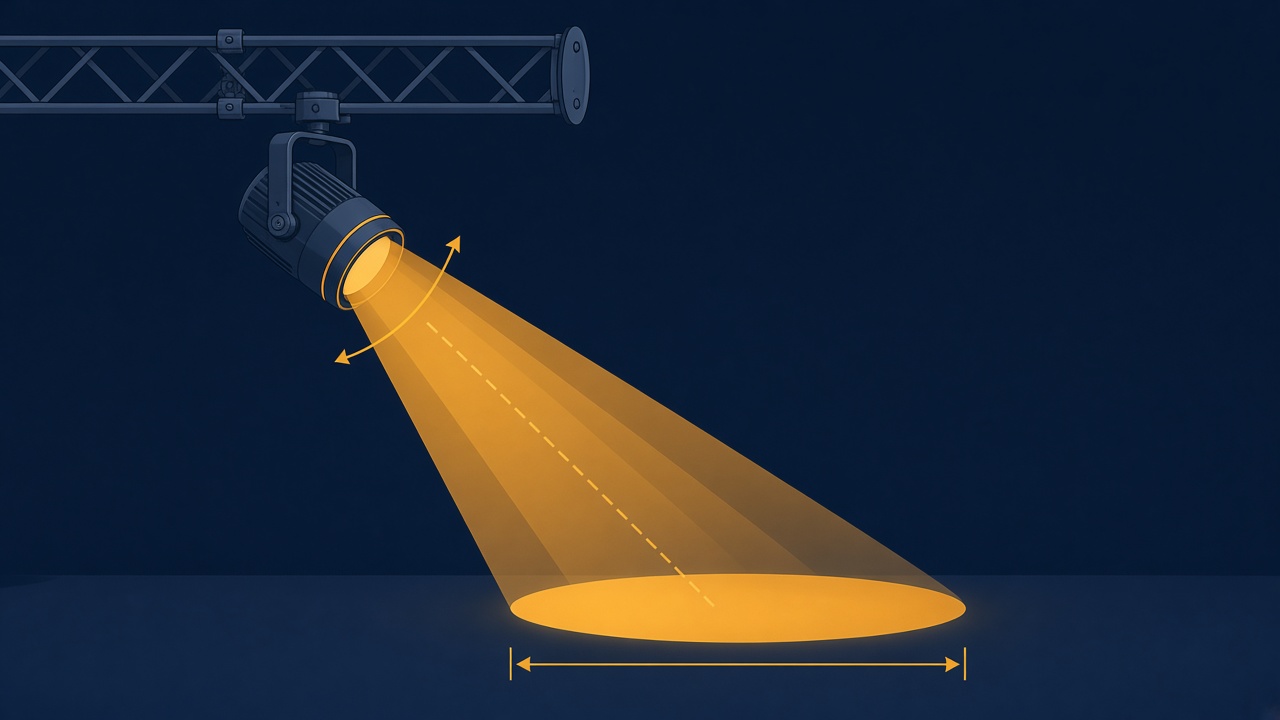
Will the light on the bar actually cover the performer on the mark? Knowing the size of the pool at a given distance saves time at focus, helps you pick the right fixture and lets you plan a rig before you reach the venue.
Short on time? Use our free beam diameter calculator. Enter the beam angle and throw distance and it gives you the diameter. If you’d like to understand the maths, read on.
Beam angle vs field angle
Manufacturers usually publish two angles, and they are not the same thing:
- Beam angle: the angle at which light intensity drops to 50% of the brightest point (normally the centre). This is the bright, usable part of the pool.
- Field angle: the angle at which intensity drops to 10% of the peak. This is the edge of the visible spill, so it is always wider than the beam angle.
When you plan coverage for a face or a performer, work with the beam angle. Use the field angle when you need to know where the spill ends, for example to keep light off a projection screen or out of the front row.
The formula: beam diameter from beam angle
If you know the angle and the throw distance (from the fixture’s lens to the surface being lit), the beam diameter is:
D = 2 × d × tan(angle ÷ 2)
- D = beam diameter (metres)
- d = throw distance (metres)
- angle = beam (or field) angle in degrees
You halve the angle because the formula works on the right-angled triangle formed by the centre line of the beam and one edge.
Working backwards: calculate beam angle from a measured pool
If you know the size of the pool and the distance, you can find the angle:
angle = 2 × atan(D ÷ (2 × d))
This helps when a fixture has no spec sheet or you want to check a zoom setting.
Worked example (metric)
Say a profile spot is rigged with an 8 m throw to a lectern, and you have a choice of a 26° (field) or a 36° (field) lens.
Profile lenses are usually named by field angle. Check the spec sheet for the beam angle before you plan coverage.
- Halve the angle: 26° ÷ 2 = 13°
- tan(13°) ≈ 0.2309
- D = 2 × 8 × 0.2309 ≈ 3.69 m field diameter
ETC lists the Source Four 26° lens with an 18° beam angle, so the bright, usable pool is smaller: 2 × 8 × tan(9°) ≈ 2.5 m beam diameter.
With the 36° lens: D = 2 × 8 × tan(18°) ≈ 5.20 m field diameter.
For a single speaker at a lectern, a 2.5 m beam (3.7 m field) is already generous. You’d probably go for the narrower lens and shutter it in further.
Now the reverse. You measure a pool roughly 3 m wide at the same 8 m throw:
angle = 2 × atan(3 ÷ 16) ≈ 21.2°
How to measure beam size on stage
- Measure the throw distance. Use a tape measure or distance meter from the front of the lens to the target surface. Remember that the throw to a standing performer’s face is shorter than the throw to the floor.
- Focus the fixture at the target, with a person or a stand-in at the right height if possible.
- Find the edges. For the beam angle you want the point where the light looks about half as bright as the centre. A light meter is the reliable way to find it, because the eye judges brightness poorly. Without a meter you’re really seeing something closer to the field edge.
- Measure across the pool through the centre, at right angles to the beam where you can.
- Calculate the angle with the inverse formula above (our calculator works forwards, from angle and distance to diameter).
Note: when a fixture is rigged at a steep angle, the pool on the floor becomes an ellipse and is longer than the formula suggests. The formula gives the diameter perpendicular to the beam.
Choosing fixtures and throw distance
- Start from the coverage you need. Decide how wide the pool must be (e.g. a 2–3 m area for a single performer), measure the throw, and calculate the angle you need.
- Long throws need narrow angles. From a balcony or FOH position at 15 m+, even a 19° lens gives a field over 5 m wide (a pool of about 4–5 m).
- Short throws need wide angles. In a small church or a low-ceiling hall with a 3–5 m throw, narrow fixtures produce tiny pools. Wider lenses or wash fixtures will cover more evenly.
- Allow for overlap. For an even wash across a stage, space fixtures so their beams overlap (as a rule of thumb, beam edges should meet or overlap slightly) rather than putting them edge to edge at the field angle.
- Remember brightness. The same output spread over a bigger pool gives less light per square metre. Illuminance falls off roughly with the square of distance, so check output (lux at distance) on the spec sheet as well as the angle.
- Zoom fixtures give you a range of angles. Check the minimum and maximum against your throw before you hire or buy.
Quick-reference table: beam diameter by angle and throw
Values are calculated with D = 2 × d × tan(angle ÷ 2), rounded to two decimals.
| Beam angle | 3 m | 5 m | 8 m | 10 m | 15 m |
|---|---|---|---|---|---|
| 5° | 0.26 m | 0.44 m | 0.70 m | 0.87 m | 1.31 m |
| 10° | 0.52 m | 0.87 m | 1.40 m | 1.75 m | 2.62 m |
| 15° | 0.79 m | 1.32 m | 2.11 m | 2.63 m | 3.95 m |
| 19° | 1.00 m | 1.67 m | 2.68 m | 3.35 m | 5.02 m |
| 26° | 1.39 m | 2.31 m | 3.69 m | 4.62 m | 6.93 m |
| 36° | 1.95 m | 3.25 m | 5.20 m | 6.50 m | 9.75 m |
| 50° | 2.80 m | 4.66 m | 7.46 m | 9.33 m | 13.99 m |
Quick tip: the diameter grows in a straight line with distance. Double the throw and you double the pool, whatever the angle.
Common mistakes
- Mixing up beam and field angle when you compare fixtures from different brands.
- Measuring throw to the floor when the target is a face 1.6 m higher.
- Using the full angle in the tan function instead of half of it.
- Leaving your calculator in radians when the angle is in degrees.
Try it yourself
Use the free Lampie beam diameter calculator to work out beam diameter from angle and throw distance.
Want to get confident with focusing, fixture choice and rig planning in a real venue? Have a look at Lampie’s lighting courses, or book a session.